
Tech Certainty in the Desert: Operational Readiness in Harsh Environments
Updated: Mar 26
The Illusion of the Corporate IT Rollout
The transition from a climate-controlled, metropolitan data center to a remote greenfield mega-project in the Middle East and Africa (MEA) is not merely a change in geography; it is a violent collision of operational paradigms. Executive leadership often falls into the dangerous trap of treating digital integration for heavy industrial assets as a standard enterprise IT rollout. This illusion is rapidly shattered the moment standard Information Technology (IT) protocols and hardware meet the unforgiving physical realities of the deep desert, the offshore ocean, or the remote jungle.
In these austere environments, the traditional procurement of generalist IT "body shops" consistently fails. These teams are accustomed to abundant bandwidth, stable power grids, and environments where a hardware failure is a minor inconvenience remedied by a quick trip to the server room. Heavy industrial capital projects demand a fundamentally different approach. Achieving true operational readiness requires what we define as a "Harsh Environment Premium", the deployment of a highly specialized, pre-integrated "Special Forces" consulting model. This requires elite technical units capable of executing flawless integration where traditional delivery mechanisms inevitably collapse under physical and logistical stress.
The Chemistry of Failure
The MEA region hosts some of the most chemically and thermally hostile industrial environments on the planet. To understand why standard integration frameworks melt down, one must look at the engineering realities of modern ultra-sour offshore developments. As detailed in recent ADNOC project analyses, the United Arab Emirates’ Hail and Ghasha mega-project is navigating extreme conditions, with the Ghasha offshore reservoirs containing lethal hydrogen sulfide (H2S) concentrations reaching up to 30 percent.
When this lethal, highly reactive chemistry is combined with the Arabian Gulf's extreme heat and high ambient humidity, it creates a profoundly corrosive atmosphere. In this environment, standard commercial-off-the-shelf IT hardware does not simply underperform; it instantly fails. The deployment of delicate Industrial Internet of Things (IIoT) sensors, network switches, and edge-computing nodes under these extreme conditions demands the absolute highest Safety Integrity Levels (SIL) for all Operational Technology (OT) equipment. If your digital integration partner does not intrinsically understand the metallurgy, the thermodynamics, and the strict environmental thresholds required to keep digital infrastructure alive in an ultra-sour gas field, your capital investment is fundamentally at risk.
The Logistics of Isolation
Beyond extreme chemistry, operational readiness is frequently threatened by profound geographical isolation. The logistical nightmare of deploying digital infrastructure in developing regions cannot be overstated, and it requires an architecture built explicitly for autonomy. According to recent global mining reports examining massive undertakings like the Rio Tinto Simandou integrated mine and rail project in the Republic of Guinea, execution requires spanning over 600 kilometers of dense, challenging terrain.
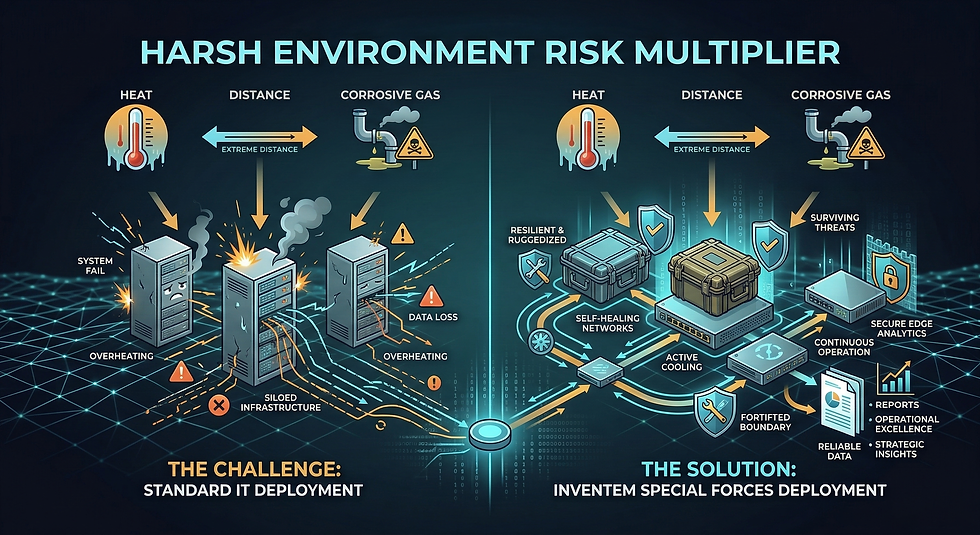
These remote environments fundamentally lack pre-existing national power grids and stable broadband telecommunications. In a corporate setting, a network failure triggers a simple dispatch ticket to a local IT technician who can resolve the issue within the hour. In the Simandou mountain range, however, physical intervention for network troubleshooting is incredibly resource-intensive, often requiring multi-day journeys via specialized transport over unpaved infrastructure. Consequently, you cannot simply "send an IT tech to the site" to fix a digital glitch. Remote resilience, self-healing network architectures, and flawless remote connectivity must be engineered into the facility's digital nervous system from the earliest stages of Front-End Engineering Design (FEED).
Surviving the commissioning phase in these extreme landscapes demands far more than generic staff augmentation. It requires what Inventem defines as the Harsh Environment Premium, a specialized delivery model that specifically includes:
Remote connectivity architecture engineered for high-latency environments.
Spares and logistics design tailored for geographical isolation.
Monitoring and self-healing networks to survive hardware degradation.
Integrated commissioning playbooks that bridge the gap between IT infrastructure and physical engineering.
To protect your next capital deployment from the devastating financial impacts of extreme environmental stress, download Inventem's master white paper, "The IT/OT Commissioning Chasm," to access our Converged IT/OT RACI Matrix and discover the proven execution frameworks required to bridge the empathy gap, eliminate integration failures, and guarantee absolute operational certainty for your next capital mega-project.


